African American Women in the Bahá’í Faith, 1899—1919
By Gwendolyn Etter-Lewis
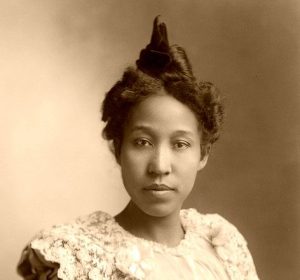
Harriet Gibbs Marshall. The second African American woman known to have enrolled in the Bahá’í Faith in 1912 was Harriet Gibbs Marshall. Mrs. Marshall had shown an interest in the Faith as early as 1910 when she began holding regular informal meetings in her home to discuss the Bahá’í Faith. (25) She continued the meetings in her home for several years.
Mrs. Marshall, the daughter of Judge M. W. Gibbs and Marie Alexander, was born in 1870 on Vancouver Island, British Columbia. She grew up in Oberlin, Ohio, the site of Oberlin College, the first institution of higher education in the United States to admit women and African Americans. She married army Captain Napoleon B. Marshall, an 1897 Harvard graduate who practiced law after serving in the military. (26) Captain Marshall is not known to have become a Baha’i.
Talented and well educated, Mrs. Marshall in 1899 became the first African American woman to graduate from the Oberlin Conservatory of Music. She majored in piano, harmony, voice, and pipe organ. Her love of music eventually took her to Paris, where she studied piano with noted pianist and composer Moritz Moszkowski. In 1902 Mrs. Marshall was appointed Director of Music for Public schools of Washington, DC.” (27)
In 1903 Mrs. Marshall realized a long held goal when she founded the Washington Conservatory of Music. The conservatory was a private institution operated exclusively by African American musicians and dedicated to providing African American students with the opportunity to study music through a conservatory approach. When the conservatory expanded in 1906 to include drama and speech, it was renamed the Washington Conservatory of Music and School of Expression. The conservatory was closed in 1960 after school officials concluded that other music institutions were meeting the needs of African American students. (28)
As founder and first president of the conservatory, Mrs. Marshall had a unique vision for the future. In 1937 she made that vision a reality by establishing the National Negro Music Center as part of the conservatory. The center was designed to be a resource in the research and preservation of African American music and to “develop a library of Negro music, present concerts and to prepare books for use in public schools on black music.” (29)
Through Mrs. Marshall’s influence the conservatory was used for Bahá’í meetings at a time when few other public facilities were open to integrated gatherings. One such meeting was hosted in 1914 by Louis and Louisa Gregory. According to a report sent to ‘Abdu’l-Bahá, the meeting attracted over one hundred people from all races and nationalities, including a Buddhist from India. It was reported that “All were anointed from a bottle of Attar of Rose sent for that purpose by Mirza Ahmad Sohrab [one of ‘Abdu’l-Bahá’s interpreters]. . . . In this way the Unity of the East and West, as well as the Fragrances of God, was manifested.” (31)
Harriet Gibbs Marshall was a gifted individual who worked tirelessly to educate young African American music students and to spread the teachings of the Bahá’í Faith. On 29 January 1937, Louis Gregory wrote to Mrs. Marshall from Haiti, saying: “You are very much loved among them [Haitians] for the constructive services you have rendered them. ‘Welcome to Haiti’, said one of the officials upon knowing that I had a letter of introduction from you. The Bahá’í seed sown by you is also having effect.” (32) Mr. Gregory was not alone in his praise of Mrs. Marshall. According to an obituary prepared by the prominent Bahá’í Mariam Haney, Harriet Gibbs Marshall was deeply loved by the Bahá’ís in her community. She never complained despite crippling arthritis in her later years, and she was known for her “loyalty and devotion” and for her sacrificial giving to the Bahá’í Fund: “The element of sacrifice was indeed in all her acts and work.” Mrs. Marshall died on 21 February 1941, having been preceded in death by her husband in 1933. (33) WORLD ORDER: WINTER 1993—1994 Volume 25, Number 2 p. 44-45
Washington Conservatory of Music and School of Expression
Her poem “Brotherhood” was published in Star of the West.
Harriet Gibbs Marshall: First Baha’i Pioneer to Haiti – Authored *The Story of Haiti: From the Discovery of the Island by Christopher Columbus to the Present Day (1930)
Harriet Gibbs Marshall BLACKPAST article
Harriet Gibbs Marshall – WikipediA article